
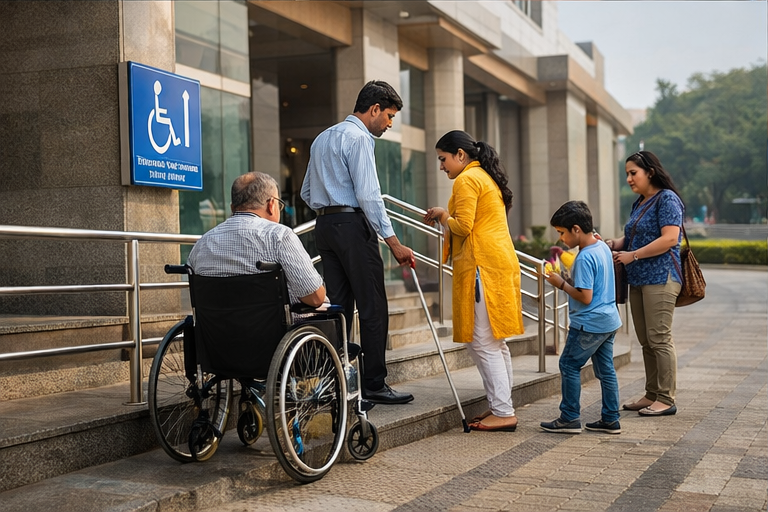
As India continues to grow and modernise, conversations around development often focus on infrastructure, technology, and economic progress. However, one critical aspect remains consistently overlooked—whether this growth is accessible to everyone. Universal accessibility is not just a design principle; it is a reflection of how inclusive a society truly is.
At its core, universal accessibility means designing spaces, systems, and services in a way that they can be used by all people, regardless of age, ability, or circumstance. It goes beyond catering only to persons with disabilities. It includes the elderly, pregnant women, children, people with temporary injuries, and even those carrying heavy loads or travelling with luggage. In reality, accessibility benefits everyone at different points in life.
In India, the need for universal accessibility is both urgent and significant. A large section of the population faces barriers in navigating public spaces—be it uneven footpaths, lack of ramps, inaccessible public transport, or absence of basic signage. For persons with disabilities, these are not minor inconveniences; they are daily challenges that limit independence, mobility, and participation in society.
Accessibility is fundamentally linked to dignity and equal opportunity. When a person cannot enter a building, use public transport, or access basic services without assistance, it directly affects their ability to work, study, and engage with the world around them. Inaccessible environments create invisible barriers that exclude individuals not because of their abilities, but because of how spaces are designed.
The importance of universal accessibility is also reinforced by India’s legal and policy frameworks. Laws such as the Rights of Persons with Disabilities Act, 2016, recognise accessibility as a right, not a privilege. Government initiatives like the Accessible India Campaign have aimed to improve accessibility in public buildings and transportation. While these efforts are commendable, the gap between policy and implementation remains a major concern.
One of the key reasons accessibility must be prioritised is the demographic reality of India. With a rapidly ageing population, the number of people requiring accessible environments is only going to increase. What may seem like a specialised need today will become a mainstream requirement tomorrow. Planning for accessibility now is not just inclusive—it is practical and future-oriented.
Urbanisation further highlights this need. As cities expand, public infrastructure such as bus stands, railway stations, hospitals, schools, and offices must be designed with accessibility in mind from the outset. Retrofitting inaccessible structures later is not only costly but often less effective. Integrating universal design principles at the planning stage ensures long-term sustainability and usability.
Accessibility also has economic implications. An inclusive environment enables more people to participate in the workforce, access education, and contribute to economic activity. It reduces dependency and enhances productivity. For businesses, accessible spaces mean a wider customer base and better user experience. In this sense, accessibility is not just a social responsibility—it is an economic opportunity.
Despite these advantages, accessibility in India is often misunderstood as an added expense rather than a necessary investment. Simple interventions—ramps, tactile pathways, proper signage, accessible toilets, and user-friendly transport systems—can significantly improve usability without major cost implications. The challenge lies not in resources, but in awareness and intent.
Equally important is the role of mindset. Accessibility is not only about physical infrastructure; it is also about attitudes. Sensitisation and awareness among planners, architects, policymakers, and the general public are essential. When accessibility becomes a shared value rather than a compliance requirement, real change begins to take shape.
Technology, too, has a role to play. Digital accessibility—ensuring websites, mobile applications, and online services are usable by all—has become increasingly important in a digitally driven world. From online education to e-governance, accessible digital platforms can bridge gaps and create equal opportunities for participation.
At a broader level, universal accessibility is about rethinking how we design our world. It challenges the idea of a “standard user” and instead recognises diversity as the norm. When spaces are designed inclusively, they do not just accommodate differences—they celebrate them.
For organisations working in the development sector, accessibility must be integrated into every initiative, whether it is infrastructure assessment, community programs, or policy advocacy. Building awareness at the grassroots level and encouraging inclusive practices can create ripple effects that extend far beyond individual projects.
India stands at a crucial point in its development journey. The choices made today will shape the kind of society it becomes tomorrow. Prioritising universal accessibility is not just about compliance with laws or global standards—it is about building a country where no one is left behind.
Because true progress is not measured by how fast we move forward, but by how many people we take along with us.